I saw a lot of interest on Re-circulating Aquaculture System shown by some visitors to this blog. My posting Introduction Of Recirculating Aquaculture System For Grouper Farming In Malaysia seem to get the most hits from the readers. In that posting, I did mentioned my wish to give my observations on the RAS that I manage to see in this country. I hope to be able to do so sometimes later. For now, let share the information on the system.
My initial exposure to RAS was way back to early 1990s when some grouper farmers in East Coast States of Peninsular Malaysia used to face high fish mortality due to heavy rainfall during monsoon season resulting in heavy losses to them. I must say, it was too early to think about RAS during that period of time when even cage culture system was considered the most "modern" technology of the day. Later on, I get involve in cage culture of grouper fishes, only to confirm how inconsistent environmental factors will greatly affect the production as well reduce the management efficiency to the lower level with a lot of uncertainty and out of control conditions. It may frustrate even good and dedicated managers.
I still remember a simple book but with very informative content published by INFOFISH with the title Recirculating Aquaculture Systems which I seriously consider as my text book during that time and remain relevant until today. (You may purchase this book on line now from INFOFISH Publication). Since then, I have seen many RAS farms in operation in many parts of the world, some in fully automatic system complete with additional support systems while others just basic RAS and some called their system as semi RAS.
One of the system that I want to mention here is an eel farm in Denmark which I visited way back in 2002 that have a production line from hatchery to finish products. The farm is using a fully automatic RAS with very minimum workers can be seen around but the fish seem to be being properly being taken care at every minutes during the farming period. In each tanks the water parameters were monitored automatically using probe sensors and reported to the control room in real time. There is no one at the control room either. Should anything odd taken place, the system will trigger the manager's and supervisor's mobile phone. To add to the sophisticatedness of the system, they are using green energy, by using wind turbine generator to supply the energy to their farm!
 |
| Abalone farming using RAS. Photo: Mahmud Ismail |
 |
| High density turbot farming using RAS |
Another system that I always remember when RAS issue arise is a farm in Spain which I visited by the invitation from a friend from Tromso University, Norway. The farm always remind me of Stadium Melawati in Shah Alam Selangor because partly, that's how it look like. The farm contain circular tanks at various level. During my visit, they were farming turbot with capacity around 500 mt per year. They were using photo stimulant to enhance the growth of the fishes, play with gravity forces to reduce the pumping costs and the fish physiology to do natural grading of the stock.
Since introduction of RAS in 1970s, so much progress has taken place in this technology. Due to global pressure in marine capture fisheries and environmental problem in pan and cage cultures this system gaining popularity in many parts of the world. In the book, Urban Aquaculture (Cabi) some writers considered RAS could be the answer to the need for environmentally sustainable production of marine farmed organisms. However, since the initial and operating costs in RAS are higher as compared to pond, cage or pan cultures, anyone who want to invest in RAS must seriously consider the kind of species they wish to culture in order to achieve economic return on the investment. Generally speaking, we should go for higher price species if we are using RAS. Nevertheless, economic of scales in slightly lower priced species could also bring a positive results.
I always consider some grouper species are economically viable to be cultured using RAS. So, our first rule of thumb in choosing either to use or not to use RAS is the economic viability based on the price of the chosen species.
 |
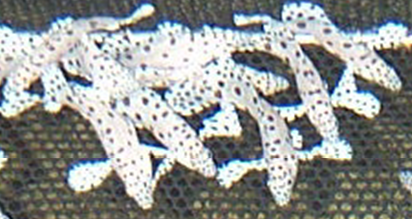
| Mouse Grouper could be a right species for RAS system. |
some writers considered RAS could be the answer to the need for environmentally sustainable production of marine farmed organisms. However, since the initial and operating costs in RAS are higher as compared to pond, cage or pan cultures, anyone who want to invest in RAS must seriously consider the kind of species they wish to culture in order to achieve economic return on the investment. Generally speaking, we should go for higher price species if we are using RAS. Nevertheless, economic of scales in slightly lower priced species could also bring a positive results. I always consider some grouper species are economically viable to be cultured using RAS. So, our first rule of thumb in choosing either to use or not to use RAS is the economic viability based on the price of the chosen species.


 This fish is so beautiful as larvae, juvenile and even adult. They tend to be a very potential species to be reared for marine aquarium fish. I remember bringing in some fry of this fish from Indonesia back in late 1990s and keept them in the salt water aquarium in my office. They look so marvelous under the aquarium lights, or even without lights. I do really love to see them swimming, they look so tender, so charming, so cute.